

Planning for What Comes Next

Why Redevelopment Now
Niagara District Airport (YCM) is approaching a period of change shaped by infrastructure improvements, evolving aviation needs, and long-term growth.
The Airport Redevelopment Project responds to these realities by setting a clear, phased path forward, grounded in safety, operational needs, and thoughtful stewardship of a municipally supported asset. It is informed by both the Strategic Plan and the 2025–2045 Master Plan. Together, these documents:
- Define Niagara District Airport’s long-term role within Niagara
- Identify infrastructure and operational priorities
- Establish a phased, achievable approach to redevelopment
- Emphasize safety, sustainability, and regional fit
Redevelopment is not a single project, but a coordinated program of improvements that unfold over time.
A Phased Approach to Redevelopment
Redevelopment is planned in stages, allowing improvements to align with demand, funding availability, approvals, and operational readiness.
Enabling Program Stage
Currently underway, this preparatory stage involves early work that prepares Niagara District Airport to transition to Stage 1 — including positioning, approvals, and pre-development steps that reduce risk and support readiness.
Stage 1
Short-Term Redevelopment
Stage 1 focuses on preparing Niagara District Airport for scheduled commercial service through infrastructure upgrades and facility modernization.
- Planning, approvals, and enabling work
- Early infrastructure and facility improvements
- Preparatory steps tied to safety and operational need
Priorities include:
- Expansion of the existing terminal
- New Combined Services Building, including equipment and capacity to support ARFF CAT 6
- Expanded parking facilities
Stage 1
Medium-Term Redevelopment
Stage 1 focuses on preparing Niagara District Airport for scheduled commercial service through infrastructure upgrades and facility modernization.
- Facility expansion and modernization
- Landside and airside improvements
- Tenant relocation and commercial area development as required
Medium-Term priorities include:
- Additional hangars, apron space, and supporting services
- Modernization of general aviation infrastructure
- Renewal of airfield maintenance and emergency response equipment
- Further terminal, airside, and landside enhancements as justified by traffic growth and regulatory needs
Stage 2
Long-Term Redevelopment
Stage 2 builds on Stage 1, with additional infrastructure and long-range development, including expanding Niagara District Airport's main runway by 2,500 ft. — aligned with demand, regulatory requirements, and future land use planning.
- Additional infrastructure tied to future demand
- Full build-out of redevelopment areas
- Ongoing modernization aligned with regional needs
Advocacy & Growth Strategy
Air access, infrastructure investment, and regional connectivity are shaped by policy, funding, and collaboration.
Advocacy ensures Niagara District Airport's needs, data, and long-term plans are understood by decision-makers and aligned with broader regional priorities. It supports informed discussion, not growth for growth’s sake.
Niagara District Airport's advocacy efforts focus on areas that directly support safe operations and responsible redevelopment, including:
- Infrastructure Funding - Securing investment to support necessary improvements and long-term resilience
- Redevelopment Readiness - Aligning approvals, timelines, and planning processes
- Tourism & Economic Alignment - Ensuring aviation access complements Niagara’s tourism and economic strategies
Working Across Jurisdictions
Niagara District Airport’s redevelopment planning is aligned with partners at multiple levels.
Support for redevelopment is built through research, data, and engagement including technical studies and analysis, economic and operational data, stakeholder and community engagement, and transparent reporting and public communication.
This alignment helps ensure redevelopment decisions are informed, coordinated, and regionally appropriate.
- Municipal - Working with the Cities of Niagara Falls and St. Catharines, and the Town of Niagara-on-the-Lake
- Provincial - Aligning with tourism, transportation, infrastructure, and economic development priorities, including the Province’s Destination Niagara Strategy
- Federal - Engaging on regulatory, funding, and aviation policy considerations
Frequently Asked Questions
This section answers questions about the airport redevelopment, including impacts on passengers, partners, and the community.
-
Have any studies been done to look a the feasibility of growing the airport?
Yes. Significant studies have been done to date that explore the feasibility of growing Niagara District Airport to welcome scheduled commercial service.
An Economic Impact Study, Airport Zoning Regulations, Route Development Study, Financial Modeling, and Airport Safeguarding (including Noise Mitigation) were all completed as part of the 2025-2045 Master Plan. Additional work, including master site servicing, geotechnical explorations, and environmental assessments is being completed as part of the recent $10 million in funding received from the Government of Ontario, announced in July 2026.
The Province also has the Niagara Air Access Feasibility Study underway, which was first announced as part of the Province’s 2025 Budget. The study is exploring opportunities to improve air access to the Niagara region, with the objective of helping inform decision making on investments related to air-related transportation infrastructure.
Additional older studies, including feasibility studies and businesses cases, are available in the Reports & Publications section on our website. -
What type of aircraft fly into the airport currently? What aircraft will be able to fly in after redevelopment?
Niagara District Airport regularly receives many types of aircraft from all over North America. Examples include single-engine planes (Cessnas, Pipers, King Air), turboprops (Q400), helicopters, military aircraft, light to medium-sized jets.
In 2025, the airport had 40,000 movements, with over 300 jets. Our Master Plan envisions reaching approximately 50,000 annual movements, suggesting a modest increase in aircraft traffic.
After redevelopment, the airport will continue to support single-engine planes, turboprops, helicopters, and military aircraft, along with larger-sized jets, narrow-body airliners (A320, 737), and regional jets (Bombardier CRJ, Embraer E195).
-
What is the projected economic impact of growing the airport?
Redeveloping Niagara District Airport will support the growth of tourism, improve travel access, and create good-paying jobs in Niagara. It will unlock new economic opportunities for our the entire region, benefiting Niagara’s hotels, restaurants, wineries, entertainment venues, historic sites, and visitor attractions.
The redevelopment project is expected to generate more than $1 billion in economic output, create over 1,000 construction jobs, and provide 500 permanent jobs once the modernized airport is fully operational. -
How is the Airport funded?
The Airport is funded by municipal contributions and generated revenues.
Of the Airport’s total 2026 budget (operating and capital) of $1.68 million, the City of St. Catharines pays 41.2% ($694k), City of Niagara Falls pays 28.4% ($479k), and Town of Niagara-on-the-Lake pays 5.8% ($97k).
-
How is the Airport Redevelopment Project being funded?
The 2025-2045 Master Plan outlines a path forward for the airport to introduce scheduled commercial service, supported by extensive financial modeling conducted as part of the planning process. Achieving this vision will require the support of government and/or private sector partners who share a commitment to growing Niagara's economy and tourism market. Additional opportunities for consideration include federal and provincial programs like the Canada Infrastructure Bank and the Building Ontario Fund.
In July 2026, the Government of Ontario announced nearly $10 million to advance redevelopment planning and design work - a significant step in advancing the project.
-
What is the ~$10 million investment from the Province being used for?
The recent investment (July 2026) of nearly $10 million from the Government of Ontario is allowing the Airport to advance planning and design work for the infrastructure improvements identified in its 2025–2045 Master Plan. This includes the onboarding of necessary partners to support the detailed design work for roadway improvements, a runway extension, a parallel taxiway, a Combined Services Building, and a new Air Terminal Building. The funding is also supporting master site servicing, geotechnical and topographic surveys, environmental and regulatory requirements, and other technical work needed to move the project forward.
-
What is the Niagara Air Access Feasibility Study (NAAFS)?
The Government of Ontario is currently leading the Niagara Air Access Feasibility Study (NAAFS), exploring how existing infrastructure like Niagara District Airport can be leveraged to enhance air access and connectivity to Niagara.
-
What steps have previously been done to modernize the airport?
The last significant modernization of airport facilities occurred in 2010 with Infrastructure Stimulus Funding (combination of dollars from Federal, Provincial, and Regional levels of Government).
-
Will the Airport need to acquire land?
Land does not need to be acquired for Phase 1 of the project, however it would need to be acquired for Phase 2.
As the project moves forward, the Airport will work with relevant jurisdictions to ensure all applicable zoning and land use requirements and approval processes are followed.
-
Do you need to expand the runway right away to begin scheduled service?
No, the runway does not need to be extended for Niagara District Airport to begin welcoming scheduled service.
The Phase 1 improvements required to accommodate increased passenger traffic include expanding the terminal to support CATSA and CBSA, building a new combined services building, and expanding parking facilities.
Our main runway would be extended from 5,000 to 7,500 ft as part of Phase 2 of the project.
-
How will the community be engaged?
Public engagement remains a priority throughout the airport’s redevelopment process. As planning and design work progresses, the Airport is committed to keeping residents, businesses, and regional partners informed while providing meaningful opportunities for community feedback and engagement.
Public Information Sessions were held throughout the development and at the launch of the Master Plan, where attendees had opportunities to share feedback that helped shape the plan. Additionally, several community presentations and tours have taken place. Additional public engagement sessions will be scheduled in the coming months to provide the community with more opportunities to engage with our team, learn more about the project, and provide feedback.
Residents can stay informed by subscribing to our quarterly newsletter, connecting with us on social media, and visiting our website for more information. Those interested in visiting the Airport can also contact our team at info@niagaradistrictairport.ca.
-
What routes will be offered?
Our 2025-2045 Master Plan explores a number of feasible route opportunities identified in the Traffic Forecast/Route Development Study, including international and sun destinations.
Ultimately, the development of future routes will depend on airline intention and market demand.
-
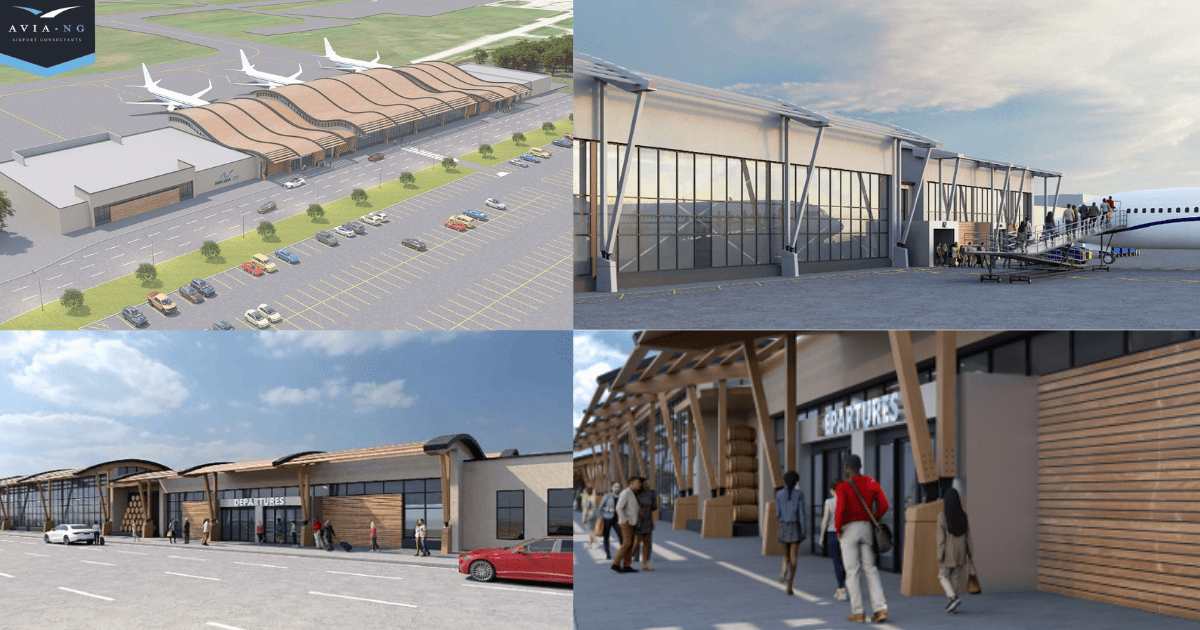
What will the new terminal building look like?
The Master Plan envisions a modest terminal building with wood tones, flowing elements and 4 terminal gates, that blends in and reflects our environment.
Conceptual renderings:
-
I live nearby the airport, and have questions about the project. What should I do?
Our team will connect with nearby property owners as the project progresses. In the meantime, we would be happy to meet with you to discuss the project and any concerns you may have. Please reach out to us at your convenience at info@niagaradistrictairport.ca.
You can also review the Land Use Development Plan in our 2025-2045 Master Plan, which shows what existing and surrounding areas are intended to be developed in the future.
-
What about noise impacts?
Noise management is an important part of responsible airport planning. Niagara District Airport monitors airport activity and complies with applicable regulations, using data and best practices to guide mitigation efforts.
The Master Plan has a dedicated chapter (#7) on airport safeguarding efforts, including noise management. As the project advances and planning continues, the Airport will implement an appropriate noise management program that will help to mitigate the impact of airport related noise – considering things like reducing noise at its source, land-use planning, noise mitigation procedures, and operating restrictions.
Noise-related concerns or questions can be submitted through our contact form.
-
Will your hours of operation change?
Aircraft are currently permitted to land at Niagara District Airport 24/7, while our administrative office and services such as jet fueling operate during designated business hours.
As the airport grows, our leadership team will determine appropriate hours of operation, taking into account route and market demand, and other external factors.
-
How can I learn more about the Airport Redevelopment Project?
We invite you to subscribe to our quarterly newsletter at the bottom of this page to stay informed about project milestones and key information related to the project as it progresses.
For more timely updates, connect with us on Facebook, X, Instagram, or LinkedIn. You can also learn more through our 2025-2045 Master Plan.
Planning With Purpose
Niagara District Airport’s redevelopment approach is shaped by long-term thinking and a strong sense of public accountability. Everything we do is guided by careful planning and a focus on aligning growth with the needs of the community and the region.